

Marine mammals do not have to spend their entire life in the sea…they just need to spend MOST of their time in the sea.
Here are seven sea mammals that are on the verge of no longer being with us:
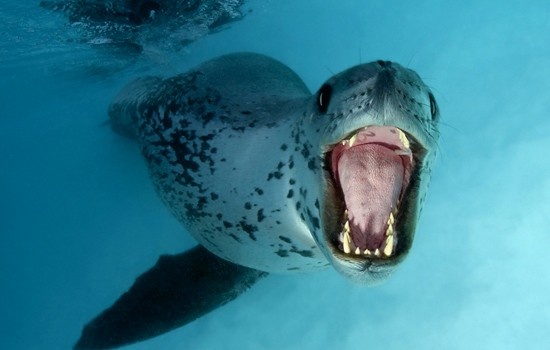
LEOPARD SEAL (HYDRURGA LEPTONYX)
You’ve probably heard of the leopard seal, well-known for being one of the world’s fiercest undersea predators; its name comes from its spotted coat, and from its huge mouth full of extremely sharp, terrifying teeth. Unlike other seals, which eat mostly fish, leopard seals feed on warm-blooded animals like seabirds, penguins and, yes, even other seals. Their diverse and surface-dwelling diet allows them to find plenty of food without needing to dive very deep.
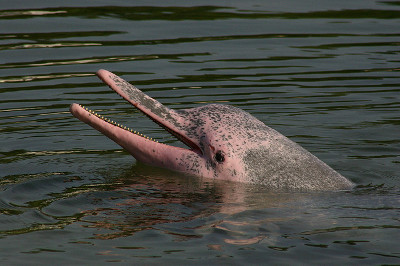
AMAZON RIVER DOLPHIN (INIA GEOFFRENSIS)
Known as the boto in Portuguese, the Amazon River dolphin is one of only five species of freshwater dolphin, four of which are severely endangered, and the last of which has gone extinct. The Amazon River Dolphin sometimes called the “pink dolphin,” though it is naturally white, taking on a pink, blue, or brownish hue depending on its diet and environment. The boto’s shape is different from sea-dwelling dolphins: it’s rostrum (snout) is extra long and thin, and instead of a pronounced dorsal fin, it has a long ridge along its back. Due to the low visibility in cloudy river waters, the boto also has tiny, poorly functioning eyes, and therefore relies almost entirely on echolocation to hunt its prey.
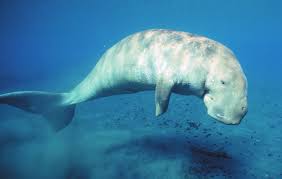
DUGONG (DUGONG DUGON)
Along with its close relative the manatee, the dugong belongs to an animal order called Sirenia, derived from the belief that these arguably human-shaped creatures inspired tales of mermaids, who sang their siren song to ill-fated sailors. Less glamorously, the manatee and the dugong are informally known as “sea cows,” and use their large, rough lips to graze on sea grasses. In actuality, their closest relative among land animals is the elephant. The dugong is in a separate family than the better-known manatee, however; while the manatee has a completely round tail, the dugong’s tail is fluked, like that of a whale or a dolphin. And while manatees can live in freshwater, dugongs are strictly ocean-dwellers, making them the only marine mammals that subsist entirely on vegetation.
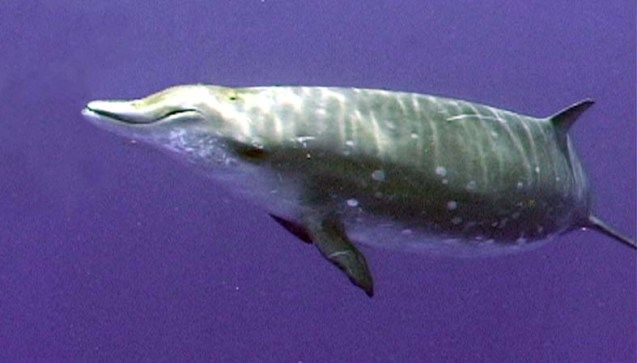
CUVIER’S BEAKED WHALE (ZIPHIUS CAVIROSTRIS)
For decades, scientists credited the sperm whale and elephant seal as performing the deepest and longest dives among air-breathing sea creatures. But recently, studies using digital tags have proven that the unassuming beaked whale leaves all other marine mammals in the proverbial dust. Cuvier’s beaked whale can dive up to 6,230 feet (1,900 meters) and for up to 85 minutes—about 2,00 more feet and 24 minutes beyond the sperm whale. It may not be the most beautiful or graceful of all cetaceans, but its thick, dense body is better suited to withstanding deep-sea pressure than to flitting about upon the waves.
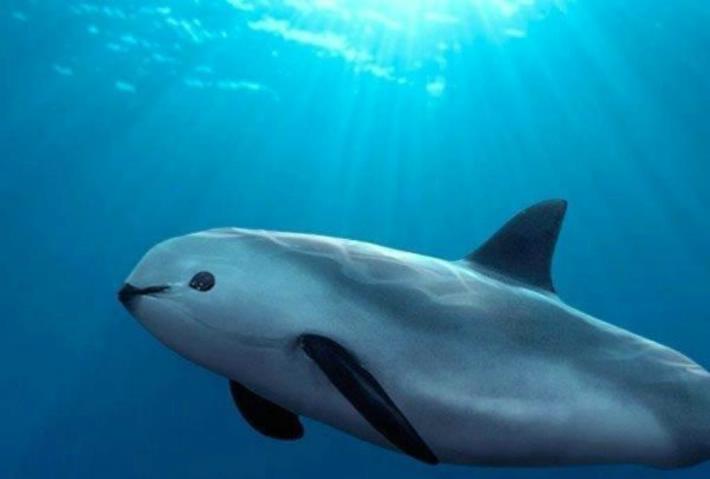
VAQUITA (PHOCOENA SINUS)
People often use the terms “dolphin” and “porpoise” interchangeably, but the smaller, snub-nosed porpoises differ greatly from their more popular cousins in the Delphinidae family. Also known as the “Gulf of California porpoise,” the vaquita’s name means “little cow” in Spanish. It is endemic to the relatively shallow waters of the Gulf of California, inside Mexico’s Baja peninsula, where commercial fishing and changes in habitat make it one of the most endangered cetaceans on the planet. It’s also the smallest of all cetaceans, at about 4-5 ft. in length.
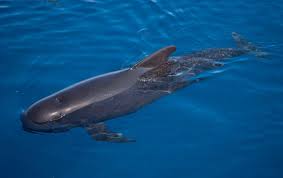
LONG-FINNED PILOT WHALE (GLOBICEPHALA MELAS)
After the killer whale (orca) and the short-finned pilot whale, the long-finned pilot whale is the third-largest member of the dolphin family, Delphinidae (characterized primarily by their cone-shaped teeth). It also looks somewhat similar to the arctic’s beluga whale; both have bulbous “melon” heads, which help them echolocate. But unlike the long-finned pilot whale, the beluga is a true whale, most closely related to the narwhal (the one with the unicorn-looking horn).
In terms of social structure, however, the long-finned pilot whale is without rival. Known for being a gregarious species, with strong, maternally based social structures, they engage in a number of showy social behaviors like breaching, fluking, even swimming in formation, and are one of the species of cetacean most likely engage in mysterious mass strandings.
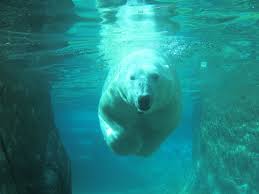
POLAR BEAR (URSUS MARITIMUS)
Polar bears are marine mammals, and spend much of their time on Arctic sea ice. Many adaptations make polar bears uniquely suited to life in icy habitats. Their fur is thicker than any other bears’ and covers even their feet for warmth and traction on ice. A thick layer of blubber beneath their fur provides buoyancy and insulation. The long neck and narrow skull of the polar bear probably aid in streamlining the animal in the water while warming the air that they breathe, and their front feet are large, flat and oar-like, making them excellent swimmers.

