

MONTGOMERY-Ending the state sales tax on groceries will remain a top item on Alabama Arise’s 2027 legislative agenda. The organization also will support a $15-an-hour minimum wage and legislation to empower counties to protect residents from potential harms of data center projects.
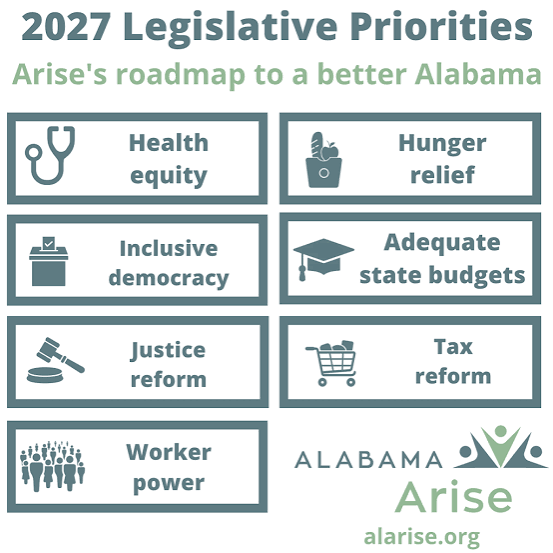
Nearly 500 members voted last week on Arise’s legislative priorities. The seven priorities chosen were:
- Health equity, including closing Alabama’s health coverage gap for adults with low incomes and protecting access to maternity care.
- Hunger relief, including protecting funding for the Supplemental Nutrition Assistance Program (SNAP) and ensuring every public school can provide no-cost breakfast for all students.
- Inclusive democracy, including no-excuse early voting and removal of barriers to voting rights restoration for disenfranchised Alabamians, as well as legislation to ensure counties can require appropriate public health and safety protections for data center projects.
- Adequate state budgets, including equitable public education funding for every student and state funding for public transportation and affordable housing.
- Justice reform, including legislation to apply Alabama’s ban on judicial override of jury sentencing decisions in death penalty cases retroactively, as well as improvements to the state’s sentencing and parole systems.
- Tax reform to build a more just and sustainable revenue system, including eliminating Alabama’s state sales tax on groceries and replacing the revenue equitably.
- Worker power to advance the health and safety of Alabama families, including increasing the state’s minimum wage and extending paid parental leave protections to more workers.

“Alabama Arise heard from hundreds of people across our state about the issues that matter most, and this agenda reflects those concerns,” Alabama Arise executive director Robyn Hyden said. “From not having enough money to afford basic needs to demanding the power to shape decisions that impact their communities, Alabamians are asking policymakers to take up real solutions to everyday problems.”
Finish it: Alabama should eliminate the state grocery tax once and for all
Arise members renewed their decades-long commitment to ending Alabama’s state grocery tax. That advocacy got results in 2023, when legislators reduced the state sales tax on groceries from 4% to 3%, and again in 2025, when they reduced it to 2%. Arise will advocate to eliminate the remaining 2% state tax in 2027.
Ending the state grocery tax remains a core Arise priority because the tax makes it harder for people with low incomes to make ends meet. The tax adds hundreds of dollars a year to the cost of a basic necessity for families. And most states have abandoned it: Alabama is one of only nine states still taxing groceries.
Lawmakers have options to remove the other half of the state grocery tax while protecting funding for public schools. Arise will continue to support efforts to untax groceries and replace the revenue by capping or eliminating the state income tax deduction for federal income taxes. This deduction is a tax break that overwhelmingly benefits the richest households.
“Reducing the state grocery tax was an important step toward repairing Alabama’s upside-down tax system,” Hyden said. “By ending the state grocery tax and limiting the federal income tax deduction, legislators can help families keep food on the table while protecting funding for public schools. Our lawmakers should act quickly to end the state grocery tax forever in 2027.”
Home rule: Ensure local residents have a say in data center projects affecting their communities
A new priority for Arise will be advocacy to ensure Alabama counties can create appropriate guardrails for data center developments. Data centers are massive developments that house large numbers of computer servers used for artificial intelligence (AI) or data storage. These projects have spread quickly across Alabama in recent years. Fifteen data centers already exist across the state, and 22 others have been proposed or are under construction, according to the Alabama Rivers Alliance.
Many Alabamians have expressed concerns about data centers’ potential effects on the economy, environment and utility costs in their communities. Several cities, including Athens, Birmingham and Hoover, have passed local ordinances to help regulate these possible impacts. Other cities like Cullman and Homewood have approved one-year moratoriums to allow more time to evaluate how to proceed.
But Alabama counties lack many of the home rule powers that state law grants to cities. That means county officials are less equipped to establish safeguards for data centers in unincorporated areas. Arise will support statewide legislation to help empower counties to respond effectively to community concerns related to data center projects. The organization also will work to promote meaningful public engagement in the assessment and regulation of these projects.
Raise the wage: Alabama should ensure fair pay for hard work
Arise members expressed overwhelming support for legislation to increase Alabama’s minimum wage to $15 an hour. Alabama follows the federal minimum wage, which has been stuck at $7.25 since Congress last increased it in 2009. That means the minimum wage has stayed the same for nearly two decades even as costs for food, healthcare, housing and other necessities have continued to climb.
A higher minimum wage would help lift thousands of Alabama families out of poverty and would boost consumer spending and tax revenues in communities across the state. Alabama remains one of only five states where lawmakers have not enacted a state-level minimum wage law. But legislators scrambled in 2016 to pass a law that preempted local governments from passing their own wage ordinances in response to Birmingham’s effort to increase its local minimum wage.
Thirty other states have chosen a different, more worker-friendly path by setting minimum wages above the federal level. That includes Florida, where the minimum wage is $15 and increases annually based on inflation. Arise will advocate for Alabama to join dozens of other states that have strengthened their economies and made it easier for families to make ends meet by increasing the minimum wage.
Media Release/Chris Sanders
Communications Director
Alabama Arise/Alabama Arise Action

