

Knowing how to identify these poisonous plants can help you avoid an itchy experience. Learn what to look for, how to treat allergic reactions, and how to control plant invasion.
Summertime usually means more time outdoors, where there is an increased risk of experiencing a brush with poison ivy (Toxicodendron radicans), poison oak (T. pubescens), or poison sumac (T. vernix). Knowing what to look for can help you avoid these toxic plants. But sometimes that isn’t enough and contact is made. It is important to know how the poison spreads, how to treat reactions, and how to safely eliminate these unwelcome plants.
Identification
Poison Ivy and Poison Oak
The leaves of poison ivy (figure 1) and poison oak (figure 2) have three leaflets. This is where the adage leaves of three, let it be comes from. The leaflets are commonly 2 to 8 inches long and 3⁄4 to 5 inches wide, and they have scattered, jagged teeth along the edges. Some have a larger tooth or lobe close to the bottom edge, giving them a mitten-like shape.
The teeth on the leaflets of poison oak tend to be more rounded (figure 2), while those of poison ivy are more pointed (figure 1). There is often a reddish spot where the two bottom leaflets join together.
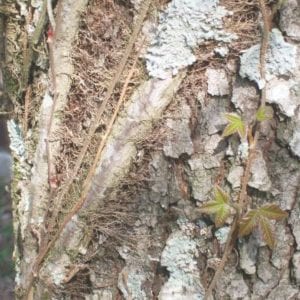
Poison ivy grows as a vine that may run along the ground or up the sides of trees, houses, or other vertical surfaces. The vines can reach more than 2 inches in diameter. Larger vines often appear “hairy” due to tiny roots that extend from the vine (figure 3). In contrast, poison oak is more shrub-like, and its leaves often are crowded near the tips of upright stems, which can reach 3 feet tall. Both species produce clusters of small white to tan fruit (figure 4).
Poison ivy is found in a wide variety of habitats but is especially common in wooded areas, along forest edges, and in urban green spaces. Poison oak is typically found in dry pine and scrub oak forests or other dry sites.

- Figure 1. Poison ivy leaves have three leaflets. Leaflets have scattered, jagged teeth along the edges and may have a larger tooth or lobe close to the bottom edge of the leaflet, giving it a mitten-like shape. There is often a red spot where the bottom two leaflets join together.
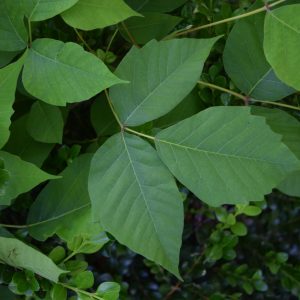
- Figure 2. Poison oak looks similar to poison ivy, but the teeth along the edges of the leaflets are more rounded, leaves often are not as shiny, and the form is more shrub-like (photo by John Byrd, bugwood.org).
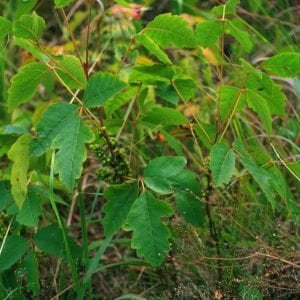
- Figure 3. Poison ivy vines, ranging in size from the thin new one on the right to the large hairy ones on the left. Note that the new stems are not as hairy. (Photo by Amber C. Marable)
Poison Sumac
Poison sumac is a close relative of poison ivy and poison oak, but it looks very different. Poison sumac leaves have seven to fifteen leaflets that are commonly 2 to 4 inches long and 3⁄4 to 2 inches wide. The leaflets, which are arranged along the stem in pairs (figure 5), are oblong with sharply pointed tips and smooth or somewhat wavy edges. The stems and leaf stalks often are a bright red color. Poison sumac grows as a shrub or small tree, reaching up to 20 feet tall, and is typically found only in open or wooded swampy areas. Smooth, greenish white fruit produced during late summer may persist on the plant through the fall and winter.
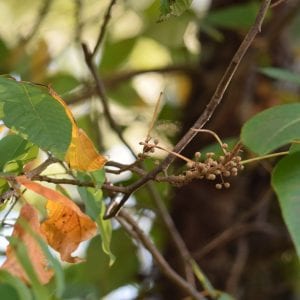
- Figure 4. Poison ivy fruit ripens in the late summer or early fall.
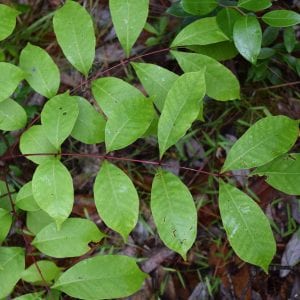
- Figure 5. Poison sumac leaves have seven to fifteen leaflets with smooth to wavy margins. Note the bright red color of the stems.
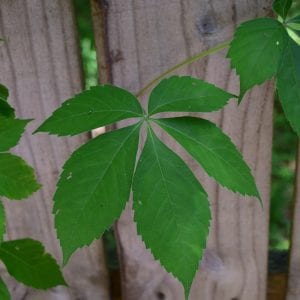
- Figure 6. Virginia creeper leaves typically have five leaflets.
Learn to recognize poisonous plants and follow these tips:
- Wear long pants and close-toed shoes when in the woods.
- Carefully inspect tree trunks to avoid any vines before touching them.
- Be wary of leafy green plants that carpet the forest floor.
- Avoid contact with these plants even if not allergic. Additional exposure may lead to development of an allergy.
- Do not burn any part of these plants. The allergen may become airborne and be inhaled.
- Wear vinyl gloves with long sleeves tucked in when weeding gardens where poison ivy is present, and clean tools and gloves when done.
- Apply a preventative lotion, such as Ivy Block, before going outdoors to help reduce exposure.
- Wash skin with soap and water or rubbing alcohol within 10 to 20 minutes if contact is suspected. Rinse thoroughly. Do not use hot water, as this may make the problem worse by opening skin pores.
- Wash clothes immediately upon return from outdoor recreation.
Media Release/Nancy Loewenstein, Amber C. Dunn, and Mark D. Smith/Alabama Extension Service

