
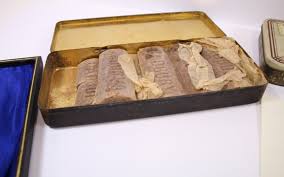
Among the highlights of a Christie’s auction in London in September 2001 was the record-breaking sale of a Cadbury’s chocolate bar to an unidentified buyer for a whopping £470 ($687). It wasn’t one of those giant candy bars that could feed a family of Oompa Loompas for a year; it measured all of 4 inches long. Nor was it some gourmet concoction produced from rare cacao beans and subjected to an oak-barrel aging process as part of an excuse to charge thousands for a tiny taste. Instead, it was a 100-year-old bar that had survived, unopened, from the first British attempt to reach the South Pole, in 1901 — part of a haul of 3,500 pounds of cocoa and chocolate stashed on the RRS Discovery under the command of explorer Robert Falcon Scott.
Why in the queen’s name was all that chocolate being carried to the frigid ends of the Earth? Well, chocolate was already renowned for its restorative and stimulating properties, which we now understand to be the effects of sugar and caffeine combined with energy-boosting antioxidants. Additionally, the soothing taste of chocolate provided some creature comforts for the roughly four dozen explorers amid extended exposure to the relentless winds and -40-degree Celsius temperatures of the White Continent.
After that initial attempt to reach the South Pole fell short by about 460 miles, Scott carefully planned a second expedition, which left in June 1910. This time, thanks to the help of his sponsors at Fry’s, the captain supplied his men with nightly rations that included 16 grams of cocoa mixed with sugar. Scott and four others successfully staggered to the South Pole in January 1912, but the presence of a tent provided the deflating discovery that they were not the first to do so. The winner of that race — by a month — had been a group led by Norwegian Roald Amundsen, who reportedly brought five times as much cocoa to fuel his push for history.
Media Release/InterestingFacts

