
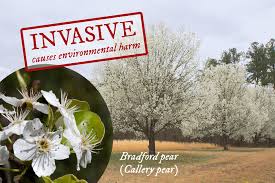
AUBURN-Popularly known by the cultivar name ‘Bradford’ pear, Callery pear has become an invasive species in natural and disturbed environments.
The introduction of Callery pear (Pyrus calleryana) serves as a cautionary tale of how good intentions can sometimes go wrong. This native of southeastern Asia was imported to the United States in the early 20th century for use in breeding programs to increase fire blight resistance in common pears. Before long it became clear that the Callery pear also had incredible potential as a horticultural tree.
With its high degree of tolerance to environmental stresses, rapid growth, and early abundant flowering, Callery pear became a very popular street and landscaping tree. While many cultivated varieties (cultivars) were developed over the years, the ‘Bradford’ is the best known. In fact, many people call the species by the name Bradford pear.
For many years, Callery pear served its purpose as a useful horticultural species. Problems began to appear, however, that had not been fully expected—problems that today’s homeowners and professionals must be aware of and know how to address.
Callery Pear Invasion
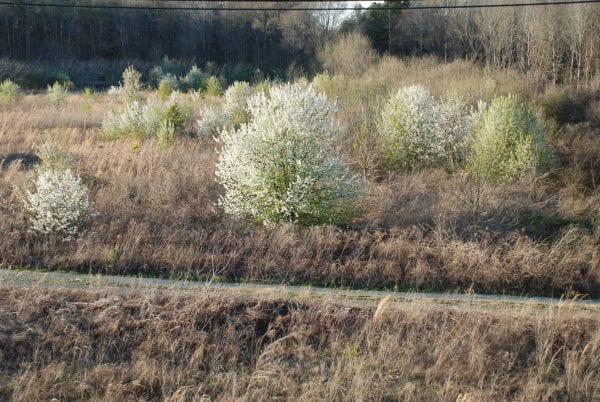
Figure 1. Callery pear colonizing an open field. Flowering can begin in trees as young as 3 years old.
Callery pears are rapidly growing trees that can form dense thickets, outcompeting native plants for light, water, and nutrients. The species has proven very successful at invading disturbed areas, open fields (figure 1), unimproved pastures, rights of ways, and forest edges. It is tolerant of partial shade and sites with dry to wet soils. As they continue to spread, it is likely that a greater array of sites will be prone to invasion, including managed pine stands.
The reason for this invasive spread lies with the way the species breeds and the fruit it produces as a result. Callery pear is self-incompatible, which means it requires outcrossing with genetically different plants for successful fruit production. Because all trees within an individual cultivar are genetically the same, they are unable to cross-pollinate.
For years, ‘Bradford’ was the most planted cultivar, and very little fruit was produced because they could not cross-pollinate. Over time, the Bradford cultivar was found to be structurally weak due to its branching pattern and was replaced with other cultivars. This shift greatly increased the genetic diversity of ornamental plantings and led to opportunities for outcrossing and successful fruiting. In many urban areas, Callery pear trees are now loaded with fruit in the fall where none were previously produced.
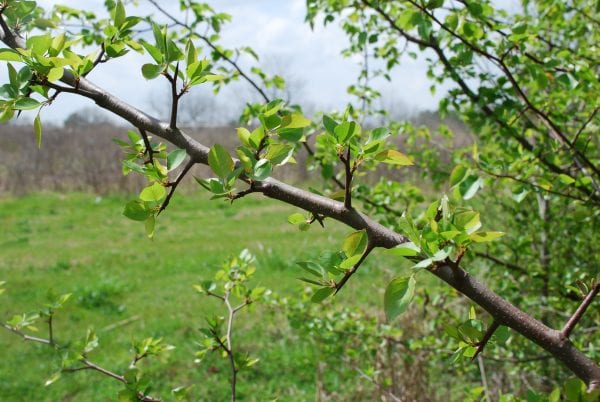
Figure 2. Sharp spur shoots (thorns) add to the problems associated with Callery pear invasions (photo by Nancy Loewenstein)
Callery pear fruit are eaten by birds and other animals, which spread the seed far and wide. As is seen in apples and other pears, the seed produced by Callery pear cultivars are not true to the parents and often appear more like the wild types from the native range. Furthermore, naturalized plants are often able to cross- pollinate and produce viable seeds. Most are very thorny with sharp spur shoots (figure 2) that persist even on older trees. The thorny spur shoots are sharp enough to puncture tires, which is especially problematic when the trees invade pastures that are mowed or bush hogged. The thorns also make control more challenging to applicators working through infestations.
Pollinators visit Callery pear flowers, but few insects utilize the leaves. This is significant because many bird species depend on leaf-feeding caterpillars and other insects to feed their young. Some birds eat the fruit, but they spread the seeds, which adds to the problem.
Identification of Callery Pear
Open grown Callery pear trees reach a height of 30 to 60 feet and are easily recognized by their teardrop shape, showy white flowers in the early spring, and brightly colored leaves in the fall. Naturalized trees are easily overlooked when not in bloom and can be a bit more challenging to identify. Following are distinguishing characteristics:
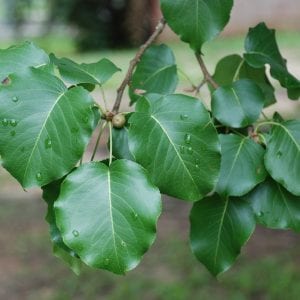
- Leaves (figure 3): Alternate, often tufted on short branchlets; oval to somewhat heart-shaped with a tapered tip, 1 1⁄2 to 3 1⁄2 inches long; finely crenate (round-toothed) margins; dark green above, light green below, developing a leathery texture with age. Fall color ranges from brilliant reds and maroons to oranges and yellows. Petioles (leaf stems) range from 1 to 2 inches long.
- Flowers (figure 4): Bloom February to April, appearing with or before the leaves; clusters of white, five- petaled flowers, 1 inch across with many maroon- tipped anthers; unpleasant scent
- Fruit (figure 5): June to February; persistent clusters of small pears, 3/10 to 5/10 inches across; green becoming tan or reddish when ripe, covered in speckles, on long stems; contain two to six maroon seeds

- Figure 3. Callery pear leaves
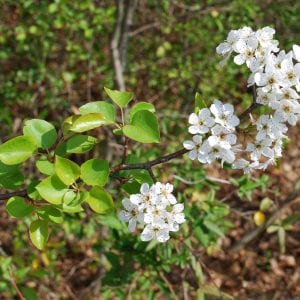
- Figure 4. Flowers appear with or before the leaves
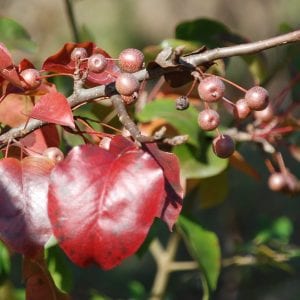
- Figure 5. Callery pear fruit and fall color
Control in Residential Areas
Consider removing planted cultivars of Callery pear from your landscape. Several native alternatives can provide similar flowers or fall color as well as much better habitat for birds and other wildlife.
- Native alternatives with similar flowers: serviceberry (Amelanchier spp.), hawthorn (Crataegus spp.), native crabapple (Malus coronaria), native plum (Prunus spp.)
- Native alternatives with fall color: Florida maple (Acer floridanum), chalk maple (A. leucoderme), blackgum (Nyssa sylvatica)
For large trees within landscapes, removal followed by stump grinding is recommended. It is important to remove lateral roots; otherwise they will continue to sprout.
Media Release/Alabama Extension Service

