
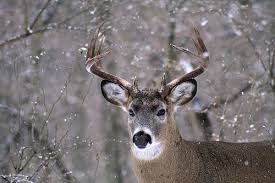
 MONTGOMERY-It happens every year. Following months of anticipation, deer season finally begins, allowing hunters more than 100 days to pursue their favorite pastime. When the season ends, many hunters complete another annual ritual − stuffing their gear away in storage until next year. While most enthusiasts will put next year’s opening day in the back of their minds, a select few will keep the candle burning. Hunters can actually obtain some of the most valuable information about the quarry they pursue in the postseason.
For many deer hunters, February is the perfect month to hit the woods and scout for potential hotspots,  which are often overlooked during the regular season. Leafless trees provide optimal visibility conditions, unlike that of the dense preseason foliage. In addition, postseason weather conditions make arduous scouting trips much more tolerable. As potential hunting locations such as mast tree groves, natural funnels, post-rut scrapes or rubs are found, use a hand-held GPS to mark those locations.
Using reflective tacks to mark trees suitable for stand placement the following year is one idea, but be aware that others may see these markers, so using GPS waypoints might be the best method. By scouting this time of year, you will better familiarize yourself with the property and lessen the amount of disturbance you make just prior to hunting season.
 If you have any tripod or ladder stands, it is a great time to move these stands to locations that are more productive or trim that one limb that was in the way the entire season. Usually the weather conditions of February are much more favorable for these activities as opposed to the dog days of August or September. Those months are typically associated with high temperatures and humidity, and the foliage is often too thick to determine what the stand location will reveal following leaf drop.
Thoroughly inspect treestands and associated parts for any damaged or worn items and replace as needed. If parts are needed, it is much easier to attain and install them now instead of just prior to the season. They may be difficult to locate at that time. If any seats or backrests are in need of adjustment, do this now. Do not wait until next year when you will most likely hunt in the stand several times before recalling the needed adjustment. If storing stands outside, remove any padded seats to reduce the possibility of the fabric dry rotting or insects damaging the foam. The wise and proactive maintenance of your treestands will not only provide a more enjoyable hunt, but also a safer one.
Wait until preseason to relocate any permanent hang-on type stands so that new manufacturer-approved ratchet straps can be used to  mount the stand. As the nylon web ratchet straps remain out in the weather for extended periods, they can deteriorate and be apt to fail or break. Replacing those straps serves as cheap insurance to increase the safety of your hunt and prevent accidental falls. As always, be sure to wear the appropriate safety gear while climbing to reduce the chances of any accidents and always be tied to the tree.
February provides an optimal time to conduct a population assessment. Natural food supplies are typically in low supply this time of year, which can increase the response and visitation to baited camera sites. Following the season’s closure, the use of scouting cameras to monitor bait stations can reveal information on the quality of bucks on your hunting tract. Prior to the advent of these scouting cameras, many hunters did not realize the true potential of the deer herd on their hunting lands. Game cameras can provide an excellent window to assess the herd quality and quantity of whitetails on your property.
 The garage or an inside closet is not a suitable location for storing clothes that will be worn for hunting deer. Many discount stores carry large, sealable plastic containers that are perfect for storing hunting clothes and gear. Use a permanent marker to identify the contents in each container. For storing clothes, a final washing in an unscented soap prior to storage can lessen the amount of foreign scent brought into the container. Place pine cones, needles and forest duff on the bottom of the container and put the clothing on top. This method imparts an earthy smell to assist in covering your scent when hunting the following year. Contents of your hunting pack should be removed, cleaned and packed neatly back into the pack for safe storage. One of the most important tasks is to develop a checklist of items in the pack and assure they are there prior to each hunt.
The simple act of maintaining and reviewing a journal of your hunts and the habitat management activities performed during the year  can save vast amounts of time, money and effort. If you’ve neglected this simple activity, start now. Jot down any information that might be useful such as which stands were more productive, were they productive a.m. or p.m., which oaks did deer prefer, did fertilizer have an effect on production, which planting was more utilized, which herbicide was more effective and so on. These notes can contribute to making you a more efficient, successful deer hunter and habitat manager.
Do not give up your deer hunting related activities when the season ends. Use the rest of the cool winter weather to learn more about your hunting property and to prepare for the next hunting season. Doing so will make you better prepared to have a successful season.
MEDIA RELEASE/WILDLIFE AND FISHERIES DIVISION /ALABAMA DEPARTMENT OF CONSERVATION AND NATURAL RESOURCES/Keith Gauldin, Wildlife Biologist, Alabama Division of Wildlife and Freshwater Fisheries

