
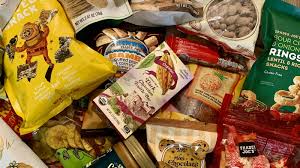
As far as ephemera is concerned, few things are as temporary as snack foods from the past. Snacking itself is an evanescent experience, a fleeting moment of between-meal indulgence or an inattentive nosh during a spectator event. But snacks are also a major part of American culture; snacking has doubled since the late 1970s, and according to the 2024 USDA survey “What We Eat in America,” 95% of American adults have at least one snack on any given day.
The idea of snacking has distinctly 20th-century origins. Eating between the traditional three meals per day was frowned upon during the 19th century, and proto-snack street foods of the time (such as boiled peanuts) were considered low class. But the Industrial Revolution, combined with a more enterprising spirit around the turn of the 20th century, created business opportunities for packaged, transportable foods, which were often marketed as novel expressions of modern technology.
As the nascent snack market emerged and grew, companies introduced countless products with varying degrees of success. Some, such as Cracker Jack (which debuted in 1896) and Oreos (which debuted in 1912 as a nearly exact imitation of the earlier Hydrox cookies), endure to this day. But history is littered with the wrappers of discontinued snacks. Here are some long-gone treats we’d love to see make a comeback.
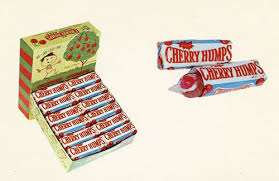
Cherry Humps
The Schuler Candy Company made this distinctive chocolate and cherry candy bar from 1913 to 1987. Each Cherry Hump bar contained two cherries, cordial, and fondant, and was double-coated in dark chocolate. In an unusual final step in their production, the bars were aged for six weeks, in order for the runny cordial and thicker fondant to meld and reach a cohesive state. Despite the cohesion achieved by aging, the filling of the candy bar still contained a more liquid texture than other candies, and this ended up being its undoing.
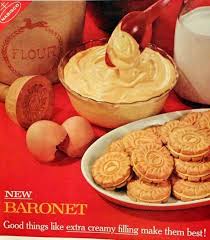
Baronet Cookies
Introduced at the beginning of the 1960s, Baronet was a vanilla creme sandwich cookie Nabisco advertised in a memorable (if repetitive) jingle as being made with milk and “country good” eggs. The appeal of Baronet cookies was in their approximation of a homemade treat: The shortbread wafers had a natural buttery flavor, and they sandwiched a filling that Nabisco claimed tasted “just like the icing on a cake.”
While they might sound like a vanilla equivalent of Nabisco’s much more famous Oreos, Baronet cookies weren’t as sweet, and they had a less ornate design than Oreos, with gently scalloped edges and embossed lines radiating from the center of the cookie. They also tended to be a little more economical than Oreos.
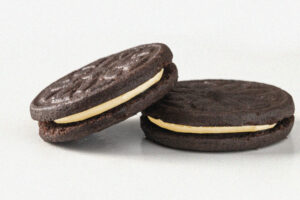
Oreos With Lemon Filling
Though today’s grocery store shelves are stocked with an amount of Oreo variants that stretches the imagination, the cookie was known for decades in a single variety: the classic chocolate wafers with vanilla creme. But when Oreos were introduced in 1912, this wasn’t the only version available; there was also a version with a lemon creme filling.
Sometimes referred to as lemon meringue, this chocolate-lemon combination is an unusual one for today’s palette, as orange tends to be the more common citrus to pair with chocolate. Then again, perhaps the chocolate-lemon combination was unusual for the early-20th-century palette as well: By the 1920s, the lemon filling was discontinued. Still, considering the sometimes bizarre reaches of today’s Oreo flavor offerings, it’s surprising the chocolate-lemon combination hasn’t made a comeback.
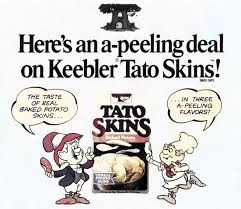
Keebler Tato Skins
Tato Skins were a potato chip snack introduced by Keebler in 1985. Unlike most potato chips, they were made from dehydrated potato flakes (as opposed to potato slices), which made them somewhat similar to Pringles. But what differentiated Tato Skins from every other potato chip was right there in the name: The ingredients included the skin of the potato, in order to give the snack a taste that approximated a baked potato. The chips even had a rough “skin side” when flipped over.
Tato Skins initially came in three flavors: cheddar cheese and bacon, sour cream and chives, and “baked potato” (i.e., no seasoning other than salt), with a barbecue flavor added to the lineup in 1987. By 2000, though, the chips had been discontinued — perhaps a victim of cuts during a turbulent era of acquisition and sale from 1996 to 2000. While Keebler’s Tato Skins division was purchased by a company that reintroduced the snack as TGIFridays Potato Skins later in 2000 (thanks to a licensing deal with the eponymous restaurant chain), the newer version was formulated differently from the original.
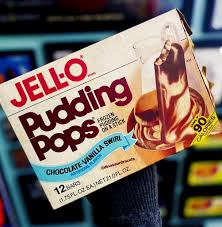
Jell-O Pudding Pops
Jell-O Pudding Pops were frozen pudding on a stick, first test-marketed on a regional basis in 1978 and introduced nationally during the early 1980s. They were developed by Jell-O parent company General Foods in order to respond to changes in eating patterns during the era. Desserts had been losing ground to portable afternoon snacks, so Pudding Pops were a way to reconfigure General Foods’ Jell-O Pudding as a portable snack. Accordingly, Pudding Pops were originally available in four classic pudding flavors: chocolate, vanilla, banana, and butterscotch. They had a smooth texture that was similar to a Fudgesicle, but with a slightly richer creaminess.
The product was a huge success from a sales standpoint. Five years after entering the market, Pudding Pops were bringing in around $300 million in annual sales. But there was trouble on the back end: Since Jell-O was generally a dry goods company, its manufacturing and distribution processes were not originally equipped to handle frozen foods. As a result, Pudding Pops required added expenditures all along the supply chain, and the snack didn’t reach profitability targets despite the encouraging sales figures.
By 1994, Pudding Pops had vanished from the freezer aisle.
Media Release/History Facts

