
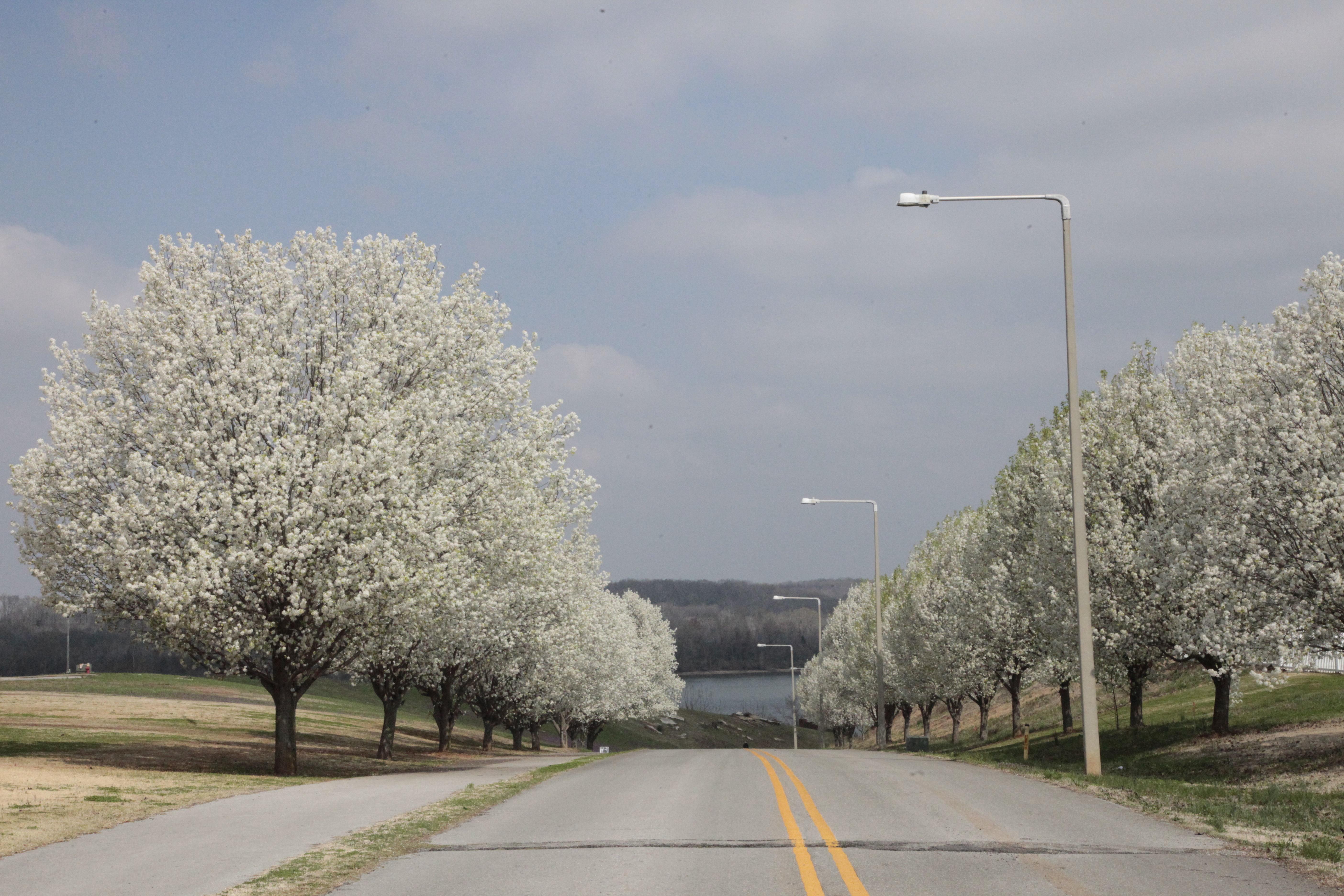
 MONTGOMERY-Each spring, Alabama’s landscape becomes increasingly dotted with beautiful flowering trees popping up along fence lines and in abandoned fields. From a distance, the white flowery trees are rather scenic, beckoning thoughts of warmer days ahead and – to some of us – inducing dreams of gobbling turkeys. However, upon closer inspection it becomes apparent that these trees are not one of our native flowering dogwoods or cherry trees, but a thorny invasive impostor—the Callery pear!
One of the most popular ornamentals in the Southeast is the Bradford pear, commonly planted along driveways and lawns its uniform teardrop crown shape, the showy white spring flowers and the brightly colored orange-red foliage displayed in autumn. It is not uncommon to see multiple Bradford pear trees on a single lawn. They grow extremely fast, produce flowers in only three years after planting and provide excellent shade all summer long.
Although these traits make it a favorite for many who want to beautify their properties, the Bradford pear brings with it some dark secrets. The growth form is such that the major branches fork at very narrow angles from the trunk. This trait, coupled with the fact that the wood is not exceedingly durable, results in splitting during periods of heavy wind or during snow and ice events.
 The original “Bradford” was cultivated in 1908 in an unsuccessful attempt to breed resistance of fire blight disease into fruiting pear trees. Although the fruits from most commercial varieties of Bradford pear trees are actually sterile, they can sometimes cross pollinate with other pears resulting in hybrids capable of producing viable fruits. This is the beginning of the real problem with the invasive, as birds and mammals relish fruits from these trees and disperse the seeds across the landscape.
Even though the cross pollinating is problematic enough, perhaps the most concerning  secret about the Bradford pear is the way in which it is cultivated. The root stock used for Bradford pears is the Callery pear from China. Even though the fruits from the above-ground pear tree might not be fertile, once the crown of the trees becomes damaged from wind and weather, the roots begin to sprout voraciously, popping up all around the tree. These sprouts are young Callery pear trees, which produce viable fruit and form dense thickets of thorny trees in a very short time. Regrettably, these trees can tolerate moderate shade and do well in a variety of soil types, making them likely to invade almost anywhere.
 There are effective methods for eliminating this invasive. To begin, instead of planting Bradford pears for the spring flowers, plant natives such as flowering dogwood, Eastern redbud, magnolia, wild plum or black cherry. There are numerous websites dedicated to promoting the use of native flowering plants for landscaping purposes, including a University of Texas at Austin website: www.wildflower.org/
If Bradford pear trees are recently planted, seedlings and shallow-rooted plants can be pulled by hand when the soil is moist. Smaller trees should be dug or pulled using a device similar in function to a Weed Wrench, which is designed to ensure the entire removal of the root system. As for larger trees, they should be cut down and the stump treated with glyphosate or triclopyr (as per label directions) or ground up to prevent resprouting by the root stock. Another option is to girdle the tree during the growing season (spring or summer) about 6 inches above the ground. Once the large trees are destroyed, it is imperative that the area around the stump is  checked regularly for unwanted sprouting.
Spring is a wonderful time of year signaling the renewing of life with the budding of flowers, the buzzing of bees, and the gentle warming of the days as each morning passes. The unfortunate truth is that an increasing number of these spring flowers across Alabama’s landscape are the offspring of Bradford pear trees, innocently planted to beautify lawns in each year. Due to the nature of these trees, however, an action intended to beautify results in a very ugly situation.
For more information, contact Jud Easterwood, Wildlife Biologist, Alabama Division of Wildlife and Freshwater Fisheries, 21453 Harris Station Road, Tanner, AL 35671; phone 256-353-2634.

