
 THE SHOALS-Sky watchers will be in for a bit of a treat the early weeks of December as the Geminid meteors will peak on the night of December 13/14. It won’t make up for the disappointment that Comet ISON disintegrated on its passage near the Sun last week, but the Geminids should put on a nice show. Since it is an annual meteor shower, there is always next year if the weather does not cooperate, more than can be said for Comet ISON which is gone forever! This year’s Geminids will peak during gibbous moon, which will dim some meteors, so the best times to watch will be after the Moon sets, but meteors should still be visible all night.
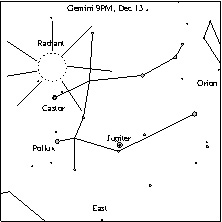
Meteor showers are named after the constellation from which they appear to emanate. If you trace back the path of the meteors in a meteor shower, they all point back to a certain spot on the sky. The constellation where the spot is located gives the meteor shower its name. A meteor is just a dust particle burning up in the atmosphere. They all appear to come from the same direction due to an optical illusion similar to the way railroad tracks that are running next to one another appear to meet in the distance. In the case of the Geminids, the meteors appear to be coming from the constellation Gemini, the Twins, near the two bright stars Castor and Pollux at the head of the Twins.
The Geminid meteors result when the Earth passes through the debris of an asteroid that may have 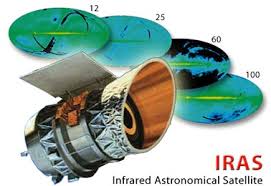 been struck by another object. This is unusual since most meteors showers occur when the Earth passes through the debris of a comet. The Geminids were first noticed in 1862, and seem to be increasing in number each year. The peak of the shower is very short and last only a few days. The particles themselves have had orbital studies performed, confirming their unusual origin from an asteroid rather than a comet. Earth and Jupiter seem to be slowly modifying the particle’s orbits. The parent object was discovered using the Infrared Astronomical Survey (IRAS) and is now named 3200 Phaethon, which may be an extinct comet. Likely the asteroid was struck by another object ejecting debris into space, producing the meteors.
From a dark location you can normally see about two or three random meteors per hour; predictions for the Geminids this year suggest up to 50 meteors per hour. One advantage of the Geminid meteors is that the constellation Gemini is visible from sunset to sunrise for northern observers and so the meteors can be watched all night. Keep an eye on the sky for meteors December 6th through to the 18th.

