

 If you’ve ever picked up a modern fantasy novel or movie, chances are you already know at least a little about some kind of dragon, whether it’s the scaly and fire-breathing kind from Game of Thrones or Lord of the Rings or the fuzzy, blessed beings in Spirited Away, Raya and the Last Dragon, and The Neverending Story.
Of course, dragons didn’t just appear out of the mist — these fantasy beings evolved over millennia of folklore, myth, and spirituality. How did dragons enter the human imagination? Did people actually believe in them? What did “Here Be Dragons” really mean on old maps?
Although dragon myths are incredibly widespread, those who study ancient folklore can only theorize about how the idea of the dragon started. Most scholars say that these stories developed independently in different parts of the world, but there are a few things that could have caused big snakes — the root of most, if not all, dragon myths — to evolve into something more legendary.
Dinosaur fossils and whale bones may have played a role in imagining these giant creatures, since most of our ancestors would have had little idea what these objects really were. One anthropologist theorizes that the idea of the dragon evolved in human minds as an amalgamation of predators like elephants, pythons, and birds of prey, which humans became hard-wired to fear. Because so many early dragon myths concern water — most regions of the world have a story of a dragon that either controls the rain or guards a body of water — one linguist theorized that rainbows are the common origin. In many early cultures, rainbows are associated with supernatural serpents who guard stores of fresh water and cause the rain to cease by drinking it.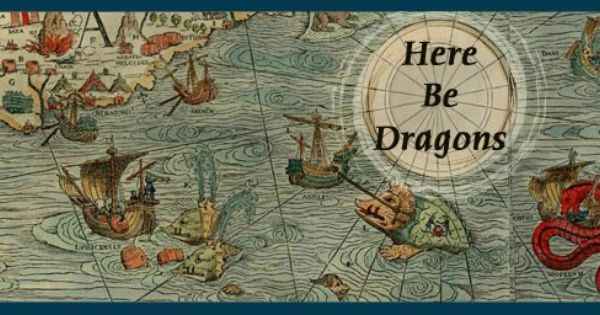
“Here Be Dragons” is a phrase that supposedly has its roots in old mapmaking, particularly before 1600 or so, as a way to indicate danger or the unknown. It’s true that cartographers often used majestic, monstrous beasts as ornaments and markers, but only one or two known early globes reference dragons specifically. No known old paper maps write out a specific dragon warning (although a couple of them do have dragons among their adornments). Fantastical drawings — of dragons, sea monsters, and more — were, in part, added to sell more maps, which were then more of a luxury item than an everyday tool.
Media Release/InterestingFacts.com

