
The act of high-fiving a friend in celebration may seem like it’s been around forever, but in fact, the gesture originated even more recently than cellphones or email. Lacking any earlier reputable reports, the most widely accepted origin story goes as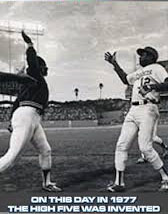 follows: The high-five was first used during a baseball game between the Los Angeles Dodgers and Houston Astros on October 2, 1977. After hitting his 30th home run of the season, left fielder Dusty Baker was greeted by his teammate Glenn Burke, who excitedly offered a raised hand to celebrate, which Baker then slapped in return. Burke then hit a home run of his own, and the pair repeated the motion.
The players celebrated another homer hit three days later with their new gesture, and that moment was photographed by the Los Angeles Times, which ran the image on the front page of the October 6 edition with the caption “GIVE HIM A HAND.” It wasn’t until 1980 that the term “high-five” was definitively coined and began appearing in print, with its first such appearance in a March 25 Boston 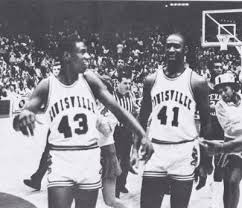 Globe article, according to the Oxford English Dictionary.
Another oft-cited report attributes the creation of the high-five to the 1978-1979 University of Louisville men’s basketball team. During practice, Wiley Brown offered his teammate Derek Smith a low-five — a knee-level gesture that was commonly used by African Americans as a symbol of unity. At that moment, as reported in The Week, Smith responded, “No. Up high,” thus giving literal rise to a new gesture. This was cited as the origin of the high-five in a New York Times article on September 1, 1980. However, this event postdates the Baker-Burke story, which makes the NYT’s claim suspect (assuming the reported timelines are indeed accurate).
Media Release/InterestingFacts

