
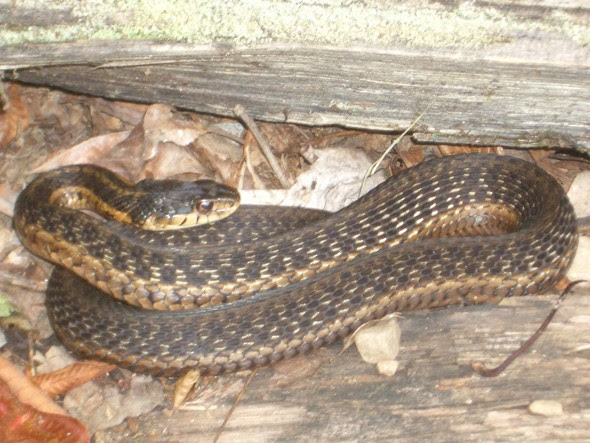
Eastern Garter Snake finding refuge under a log pile
MONTGOMERY-During the warm days of spring and summer months, most of us in Alabama are familiar with the saying, “watch for snakes!” However, as temperatures begin to drop and jackets come out, our concern for snakes begin to drop as well. This is due to snakes exhibiting a physiological behavior called brumation. Brumation is a state of lethargy or inactivity exhibited by reptiles during winter or extended periods of low temperature. During this time, a snake’s activity, body temperature, heart rate, and respiratory rate will drop as they take refuge in rock crevices and burrows to stay warm. Sounds a lot like hibernation, right? However, brumation is not true hibernation, snakes being cold-blooded animals, will sometimes move on warmer winter days to find water. True hibernators will remain in a deep sleep and not move at all. So, the next time you find yourself out and about on a warm winter day, do not be surprised if you see a snake out taking the opportunity to warm up!
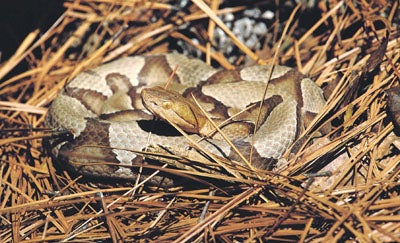
Snakes are scaly, legless, sometimes venomous reptiles having a long, tapering, cylindrical body. Unlike lizards they lack limbs, external ear openings and eyelids. Their life styles vary; some are active by day, others at night. Some occupy terrestrial or subterranean situations, others live in trees or in the water. All snakes are carnivorous and swallow their prey whole. They continue to increase in length throughout their lives, but the growth rate slows after maturity is reached. Snakes periodically shed their outer layer of skin, usually in one piece beginning at the tip of the snout.
The majority of snakes encountered in Alabama are non venomous, but often times are confused with the 6 venomous snake species we have in Alabama. Taking time to learn the differences between the 2 groups of snakes can be beneficial when encountered with one in the wild.
Non Venomous Snakes in Alabama
One way to help you identify what species of snake you found is to look at the dominant colors. Click on the link above to see a guide to snake species in Alabama based on their color.
Media Release/Alabama Department of Conservation and Natural Resources

