
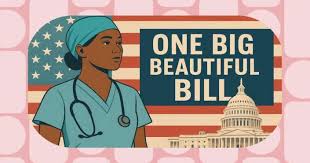
CHICAGO, IL-Fiscal incentives to expand Medicaid will end. Increased costs for Affordable Care Act (ACA) marketplace enrollees. Medical students will have fewer options to pay student loans. Physicians can expect to see these significant policy changes and others under the One Big Beautiful Bill Act of 2025 (OBBBA) starting in January 2026.
Signed into law in July, the massive budget-reconciliation bill will reduce funding for federal health programs and restrict access to health coverage, said AMA Board Chair David Aizuss, MD, during an AMA Advocacy Insights webinar in November.
As a result, 10 million people could lose health-insurance coverage by 2034, said Dr. Aizuss, citing projections from the Congressional Budget Office (CBO). Meanwhile, if the Affordable Care Act (ACA) “enhanced premium tax credits are not extended past the end of 2025, CBO estimates that the number of uninsured people will increase by more than 14 million in 2034,” he added. For more on that issue, read this AMA issue brief (PDF) and this letter from the AMA and 90-plus physician organizations (PDF).
In the coming years, on the Medicaid side, OBBBA requires more frequent eligibility redeterminations and imposes work requirements for Medicaid expansion enrollees, and restricts how states finance their share of costs and how they pay physicians, health care organizations and other health professionals.
And over the next several years on the marketplace side, OBBBA and marketplace changes “shorten enrollment windows, eliminate automatic re-enrollment and make it harder to get and maintain affordable coverage,” said Annalia Michelman, senior attorney with AMA Advocacy Resource Center. Michelman joined Dr. Aizuss and other AMA policy experts for the webinar to discuss the impact of OBBBA provisions on patients and physicians.
The AMA has created a landing page outlining the changes to Medicaid, the ACA and other key provisions of the One Big Beautiful Bill Act with easily digestible summaries and a one-stop shop for the AMA’s press statements and advocacy on the legislation that will have a major impact on the health care landscape for years to come.
Among other resources, the AMA has developed a summary of select OBBBA provisions and when they are being implemented (PDF). Here’s more detail from the AMA on four of the big OBBBA-related changes that are set to take effect in 2026.
State Medicaid expansion incentives
The American Rescue Plan Act of 2021 created an incentive for states to expand their Medicaid programs to cover all adults with incomes below 138% of the federal poverty line. With this incentive, any non-expansion state that adopted Medicaid expansion received a two-year, five-percentage point bump to its Federal Medical Assistance Percentage (FMAP; the share of Medicaid costs paid by the federal government) for Medicaid expansion expenditures.
OBBBA ends this incentive in 2026. Although two states expanded their Medicaid programs in recent years and are currently receiving the enhanced FMAP, 10 states have yet to adopt Medicaid expansion and now face fewer incentives to do so.
Removal of tax liability cap
For ACA marketplace subsidies, most tax credits are provided as advance premium tax credits, meaning that an enrollee predicts their income at the beginning of the year, and assistance is based off that estimate. If that estimate is incorrect and an enrollee’s income is higher than predicted, there are tax credit-repayment requirements.
Before the OBBBA, repayment limits varied by income, and low-income people were protected by caps on repayment requirements. But going forward, those caps that protected low-income enrollees from suddenly having to repay their tax credits are now gone, and many could have significant financial liabilities as a result, explained Emily Carroll, also a senior attorney with the AMA Advocacy Resource Center.
The OBBBA also effectively terminates the continuous special enrollment period for people with incomes below 150% of the federal poverty line. Starting in 2026, people who enroll in ACA Marketplace coverage during a special enrollment period that’s based on the individual’s income—and not tied to a qualifying life event such as loss of coverage, marriage or a child’s birth—will not be eligible for premium tax credits.
Without access to these credits, ACA Marketplace coverage will be unaffordable for many of these individuals.
Tax credits for lawful residents
Changes to the eligibility of lawfully present noncitizens for ACA Marketplace premium tax credits also take effect Jan. 1.
One provision would restrict eligibility for tax credits to noncitizens who are lawful permanent residents (i.e., green-card holders), granted status as a Cuban or Haitian entrant, or are in the U.S. through a Compact of Free Association (i.e., citizens of the Marshall Islands, Palau or Micronesia). Other previously eligible categories of noncitizens—such as refugees, asylees and recipients of Temporary Protected Status—will no longer be eligible for the credits.
The OBBBA also eliminates a special rule that allowed lawfully present noncitizens with incomes below 100% of the federal poverty line—but who are ineligible for Medicaid coverage due to their immigration status—to receive premium tax credits for ACA Marketplace coverage. For more information, see the AMA issue brief (PDF) on changes to ACA marketplace eligibility and access for immigrants.
Media Release/AMA
Jennifer Lubell
Contributing News Writer

