
MONTGOMERY-Dave Armstrong is planning to go hunting when the weather cools off, but he actually hopes he doesn’t find an abundance of the species he’s stalking.
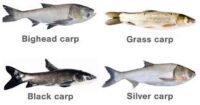 Armstrong is the Aquatic Nuisance Species Coordinator with the Alabama Department of Conservation and Natural Resources’ (ADCNR) Wildlife and Freshwater (WFF) Division, and he and the Fisheries Section staff will be searching for several invasive carp species – silver, bighead, grass and black. Those carp, especially the silver, can be detrimental to native aquatic species in riverine habitats, including the Tennessee River lakes – Pickwick, Wilson, Wheeler and Guntersville – that traverse the northern third of Alabama.
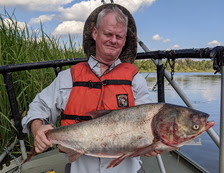
WFF’s Dave Armstrong holds a big silver carp taken from Pickwick Lake. ADCNR photo
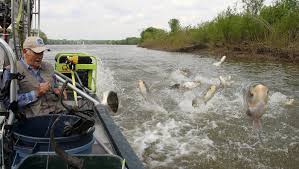
Anyone who has spent a little time on the internet has likely seen the photos or videos of silver carp jumping around boats in huge numbers that require the boat passengers to wear protective gear to keep from being injured by the flying carp.
More important than the hazards of the jumping fish is the destruction of aquatic habitat. The silver carp is a filter feeder that consumes zooplankton and phytoplankton, basically the bottom of the food chain. That means the carp are competing with other fish species, including native shad and bream populations, in that body of water for the food supply.
Fortunately for Alabama, populations large enough to cause the above problems have not been found in the state.
“I’d say the silvers are in relatively low to moderate abundance in Pickwick,” Armstrong said. “They are fairly rare to uncommon in Wilson. We picked up four last year, and TVA (Tennessee Valley Authority) picked up three in Wilson over several years. A couple were reported to WFF in Wheeler around Flint Creek, and one in Guntersville.”
Armstrong said the WFF staff conduct electrofishing operations on Pickwick and never pick up a carp at certain times of the years. At other times, they find several.
“When we go to sites in the fall or especially in the winter when they’re all huddled up, looking for warm water in the coves and creeks, that’s the time where we really get them,” he said. “We can go from zero to 10 or 20, especially when we have multiple boats. We’ve been assisting tagging efforts for the last three years with TWRA (Tennessee Wildlife Resources Agency) and the federal agencies. We’ve been tagging a couple of hundred each year to see where these fish are moving. We leave some in Pickwick, and we take some downstream to Kentucky Lake to see if they are moving back through the dams.”
Earlier this year, the Nashville and Mobile districts of the U.S. Army Corps of Engineers held public meetings about the possible methods of mitigation to keep these invasive species from spreading. The discussion centered around the Corps’ pilot program, which requires a report to the U.S. Congress on “analysis of the effectiveness of the innovative technologies, methods, and measures used in projects carried out under the pilot program at preventing the spread or managing the eradication of Asian Carp.” The pilot program partners include ADCNR, U.S. Fish and Wildlife Service, U.S. Geological Survey, TVA, TWRA, Mississippi Department of Wildlife, Fisheries and Parks, and the Kentucky Department of Fish and Wildlife Resources.
The program is designed to monitor invasive carp passage at locks and dams with an array of acoustic telemetry receivers that will identify the movement of tagged invasive carp to estimate passage rates at key locations throughout the system.
Armstrong said the public meetings, including one at Florence, were designed to fine tune the pilot program and gain public input on the issue.
“That process determines what we need to do and basically modeling what’s the best approach on where to put these deterrents,” he said. “Currently, there are seven critical locations on where to put the carp deterrents.”
Although several different methods are being considered, Armstrong said it comes down to three deterrent features – sight with flashing lights, sound with acoustic blasting and carbon dioxide injection. Those potential critical deterrent locations include Barkley Lock and Dam (Cumberland River), Kentucky Lock and Dam (Tennessee River); Cheatham Lock and Dam (Cumberland River); Jamie Whitten Lock and Dam (Tennessee-Tombigbee Waterway); Wilson Lock and Dam (Tennessee River); Pickwick Lock and Dam (Tennessee River); and G.V. ‘Sonny’ Montgomery Lock and Dam (Tennessee-Tombigbee Waterway).
“These are intended to keep them downstream from their intended paths,” Armstrong said. “Those dams on the Tenn-Tom will prevent the spread of the carp coming south into the Mobile Delta or into the Alabama River. We have bighead carp, and we have captured this species for decades, but we only find one or two. We have only found one black carp in Pickwick.”
“We have been working at the federal level for several years to obtain funding for these barrier systems to protect the Alabama fisheries,” said Conservation Commissioner Chris Blankenship. “I have made several trips to DC on this issue. We worked with Senator Britt to include language in the appropriations bill to include the Whitten Lock and Dam to provide a barrier to keep the carp from the Tombigbee, Mobile and Alabama Rivers. I appreciate her staunch support and the support of Representatives Aderholt and Strong on this critical issue.”
Thankfully, the silver carp need specific water and environmental conditions to be able to spawn, including the length of the rivers between dams. Armstrong said a team of TVA hydrologists have modeled what it would take for discharge or flow to produce a spawn that would yield recruits into the systems.
“A large number of models have shown that most of the areas in Alabama are considered ‘dead zones’ as far as the conditions for a spawn,” he said. “Pickwick is long enough, but the fish typically need 30 to 60 miles of river flow for those eggs to bounce along and stay oxygenated before they settle out. That also includes flow rate. In a high discharge year, that likelihood gets higher for them to recruit.
“It’s kind of like striped bass, which also have to have long distances for the eggs to be viable. But on the Coosa, we’re getting the benefits of the fish spawning in Georgia, and the eggs are bouncing into Alabama and surviving.”
Armstrong said the good news is that the Fisheries Section is not seeing indications that the silver carp are reproducing in the Tennessee River.
“We’re not seeing much if any reproduction in any Tennessee River system,” he said. “When I say we, Tennessee and Kentucky biologists are doing far more intensive surveys, and they’re not seeing much. There was a 2015 spawn that migrated through locks and dams from the Ohio River into the Tennessee River system. But those fish are starting to age out and have high mortality. That set of recruits are actually dying out fairly quickly. However, there have been spawns in the Ohio River, and some of those fish are locking through at Kentucky and Barkley. As you can imagine, the higher priority for these deterrent methods is going to be at Kentucky and Barkley.
“We have a specific push net we use to look for young carp from spawns, but we haven’t found any recruitment in Alabama. In many samples through the reservoirs, we haven’t picked up any juvenile invasive carp. We’re going to sample Pickwick and Wilson hard this fall. We’ll be out the whole month of October.”
Media Release/DAVID RAINER/Alabama Department of Conservation and Natural Resources

