
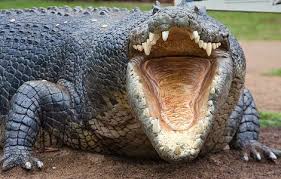
The jaws of a crocodile are an amazing specimen of evolution. With a second jaw joint unlike anything found in mammals, a crocodile can spread the force of its tremendous bite throughout its mouth. In fact, crocodiles have the most powerful chomp in the animal kingdom, at 3,700 pounds per square inch for a saltwater crocodile — 30 times the force of a human bite. But that’s not the only interesting thing about a crocodile’s mouth: Their tongues are incapable of getting between those devastating jaws thanks to being permanently rooted to the floor of their mouths. A crocodile’s tongue is also held in place by a membrane attached to the roof in the back of the mouth, which keeps the throat closed when the animal is submerged.
A crocodile’s immobile mouth muscle isn’t a new trait — its most famous ancient ancestor, the Tyrannosaurus rex, also couldn’t move its tongue (a fact Jurassic Park got very wrong). Researchers in 2018 compared the T. rex’s hyoid bones, the bones responsible for supporting the tongue, to those of modern birds and alligators, and found they exhibited tongue inhibition like the kind seen in modern crocodilians. The king of dinosaurs likely had an immovable tongue for similar reasons. With a bite that delivered 12,800 pounds of force per inch — four times that of even the crocodile — T. rex biology made sure to keep crucial body parts (i.e., the tongue) out of the way of the most powerful bite to ever walk the Earth.
Media Release/InteretingFacts

