
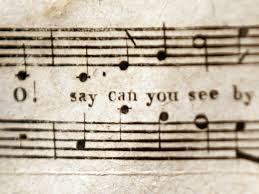
It’s easy to bungle or forget the lyrics to “The Star-Spangled Banner.” But it may shock you to learn that most people only know a quarter of the song to begin with. The U.S. national anthem actually contains four stanzas, the last three of which are almost always omitted in live performances for brevity’s sake. Despite one verse being favored, however, all four are part of Francis Scott Key’s original 1814 poem that the national anthem is based on.
Key wrote the poem soon after the Battle of Baltimore in the War of 1812, during which British forces bombarded Maryland’s Fort McHenry for 25 hours. As the smoke cleared in the wake of the battle, Key saw the American flag still flying over the fort, signifying a U.S. victory.
The familiar first verse begins with “O say can you see” and ends with the question, “O say does that star-spangled banner yet wave / O’er the land of the free and the home of the brave?” It refers to “bombs bursting in air,” while the second verse discusses the “dread silence” after battle. The second verse also celebrates the flag still flying as a symbol of a U.S. victory after the fighting.
In Key’s original manuscript, he swapped out the question mark in the first verse with an exclamation point in the second, thus ending with a definitive and joyous declaration: “‘Tis the star-spangled banner, O long may it wave / O’er the land of the free and the home of the brave!” With two additional verses, the song ultimately totals 32 lines and 32 bars of music. If you were to perform it in its entirety, the anthem would take around six minutes or sometimes far more to sing — a long time to be on your feet at the start of a game.
Media Release/InterestingFacts

